
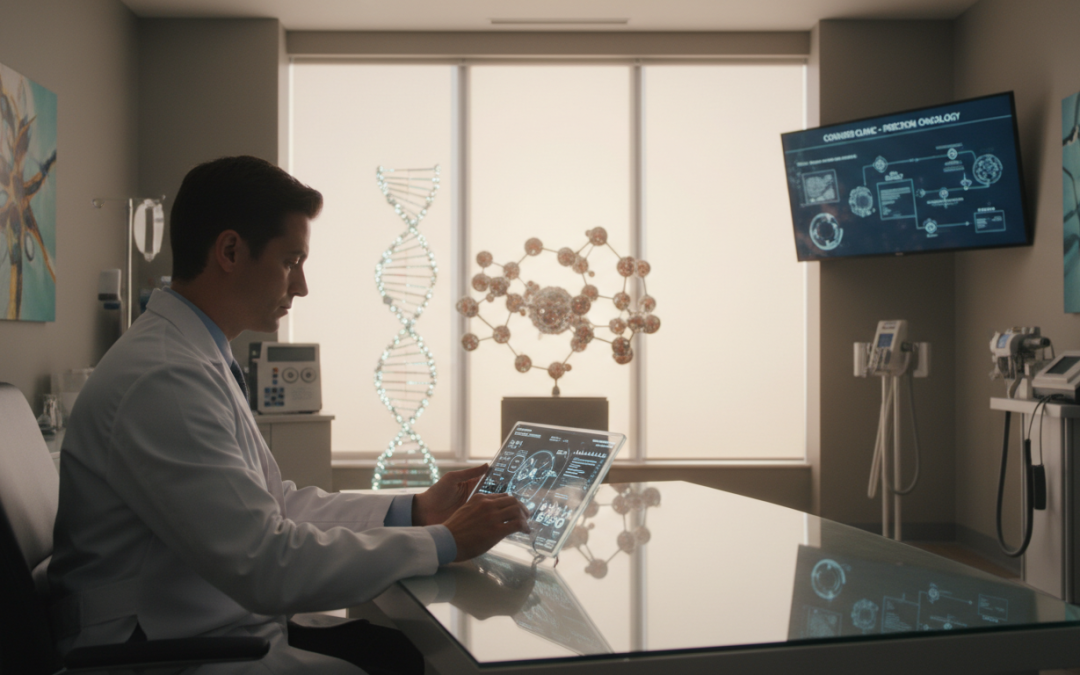
I remember a patient who felt lost after a diagnosis. Standard options didn’t feel right for their body. Their journey changed when we looked deeper, at the unique blueprint of their illness. This is the heart of modern precision medicine.
This approach uses information from your genes and proteins to guide decisions. It moves beyond a one-size-fits-all model. Advanced testing can reveal the specific mutations driving a tumor. This knowledge allows us to select therapies with much greater accuracy.
At Conners Clinic, I bridge this cutting-edge science with integrative support. My goal is to build a care strategy that respects your whole health. It’s about creating a treatment path as unique as you are.
Research strongly supports this shift. A key study on personalizing cancer treatments showed that matching therapy to a patient’s tumor biology significantly improves outcomes. This is the future of compassionate, effective medicine.
Key Takeaways
- Precision medicine uses genetic and molecular information to guide care, making it highly specific.
- Every person’s illness is unique, which is why a tailored approach is essential for better results.
- Advanced genetic testing analyzes tumor mutations to find the most effective therapeutic options.
- Integrative clinics combine this advanced science with holistic support for the whole patient.
- Recent research confirms that personalized regimens improve treatment response and safety.
- This model represents a major shift from standardized protocols to truly patient-centered care.
- Understanding your body’s specific biology empowers you to make informed health decisions.
Exploring Precision Medicine in Cancer Care
The discovery of genetic differences in tumors marked a pivotal turn in how we understand and combat this disease. Researchers found that these variations explain why two people might respond differently to the same therapy. This insight is the foundation of a more effective model.
Defining Precision and Personalized Medicine
In my practice, I define precision medicine as a strategy where care is planned using specific data from a person’s genes and proteins. It’s an evolving approach that moves beyond guesswork. We analyze the unique molecular profile of an illness to guide our decisions.
This is deeply personalized. It acknowledges that every patient’s biology is distinct. Standard protocols often fail because they don’t account for this individuality.
The Evolution from Standard to Targeted Therapies
For years, oncology relied on broad methods that affected both healthy and sick cells. The results were inconsistent and side effects were high. We needed a smarter way.
The shift began with advanced genetic testing. This tool identifies the specific mutations driving growth. With this information, we can match a patient with targeted therapies designed for their tumor’s biology.
This evolution means better outcomes and fewer risks. It represents the true future of compassionate, effective care.
Unraveling Genetic Profiling and Biomarker Testing
To truly personalize care, we must first decode the unique biological language of a patient’s illness. This process starts with advanced genetic testing and molecular analysis.
Understanding DNA, Gene Mutations, and Tumor Characteristics
Genes are segments of DNA inside each cell. They provide the instructions for building proteins.
When a mutation occurs in these genes, it can lead to abnormal cell growth. This is often the start of tumor development.
Every cell in the body contains this code. Altering it changes how a cell behaves.
Role of Biomarker and Pharmacogenomic Testing
Biomarker testing examines tumor cells for specific changes. These changes dictate how a disease will behave and respond.
We perform molecular profiling on a sample of tissue or blood. This gives us a deep understanding of tumor characteristics.
Pharmacogenomic testing is different. It looks at a person’s inherited DNA to predict how they will process a drug.
This is vital for minimizing adverse reactions and selecting the safest options.
| Test Type | What It Analyzes | Primary Goal |
|---|---|---|
| Tumor Genetic Profiling | DNA from tumor cells | Identify driving mutations |
| Biomarker Testing | Proteins & gene changes in cancer cells | Predict treatment response |
| Pharmacogenomic Testing | Inherited DNA from blood | Forecast drug metabolism and risk |
We use this detailed information to ensure care is as precise as possible. It targets the specific biology of the disease.
Individualized Cancer Treatment Plans: A Personalized Approach
Imagine a therapy designed not just for a disease, but for the exact molecular signature of your illness. This is the promise of a truly personalized approach. It moves beyond guessing to using concrete information from your body.
Large projects like Dana-Farber’s Profile initiative prove this is possible. They have analyzed over 50,000 tumor samples. This creates a massive database of genetic abnormalities.

Targeted therapy is a key tool here. It attacks specific markers on cancer cells. This often means fewer side effects than older, broader methods.
By using advanced genetic testing, we identify the specific mutations at work. We can then select the most effective options. This process prioritizes what is most likely to help.
Matching Treatments to Unique Molecular Profiles
My goal is to match a regimen to the unique biology of your tumor cells. Every person’s condition is distinct. Our strategy must reflect this.
Modern precision medicine uses this data to block the signaling pathways that allow sick cells to divide. We avoid treatments that may not work based on the tumor’s genetic makeup.
This data-driven path requires careful navigation. I always maintain a focus on the patient’s overall health. It’s about smart, compassionate care.
Research into these profiles is constantly finding new ways to intervene. This is how we build a plan as unique as you are.
Navigating Treatment Options and Managing Side Effects
Modern oncology offers powerful tools, but their success hinges on careful management and personalized application. A crucial part of any therapy is preserving a patient’s quality of life. We must balance aggressive action against sick cells with protecting overall health.

Targeted Therapies, Immunotherapy, and Smart Drug Delivery
In precision medicine, we commonly use targeted therapy and immunotherapy. These are designed to attack specific markers on sick cells. The goal is to leave normal, healthy cells largely unharmed.
This approach often leads to fewer and less severe side effects. It’s a smarter way to fight the disease. We carefully evaluate all options to ensure benefits outweigh risks.
Looking ahead, smart drug delivery systems represent an exciting frontier. Research aims to create treatments that release medicine based on the body’s signals. This could precisely control dose and timing to reduce toxicity.
Every person reacts differently. That’s why we use DNA and molecular data to guide our clinical decisions. By monitoring the response, we can adjust the plan to minimize side effects. Our ultimate goal is effective care that keeps the patient as comfortable as possible. To explore a personalized care strategy built on these principles, I encourage you to learn more.
Innovative Research, Clinical Trials, and Future Directions
One of the most exciting frontiers in medicine is the ability to track disease progression through a simple blood draw. This progress is powered by collaborative projects like the GENIE database, which now holds over 100,000 tumor profiles. This vast pool of information accelerates our understanding and shapes the future of care.
Breakthroughs in Liquid Biopsies and Molecular Profiling
Liquid biopsies are a non-invasive tool. They analyze blood to detect illness and monitor for resistance in real-time. This is a game-changer for molecular profiling.
In colorectal cancer, biomarkers like KRAS and MSI guide the choice of targeted therapy. For patients with advanced lung cancer, clinical trials are essential. They test new treatment options that may offer better outcomes.
The Impact of Multi-Omics and Digital Health Innovations
Multi-omics approaches combine DNA, RNA, and protein data. This gives a complete picture of how sick cells evolve. We use information from these analyses to find new targets for therapy.
Digital health tools track patient data effectively. They help manage side effects and improve overall health. Every breakthrough brings us closer to a future where this condition is more manageable.
Embracing Your Healing Journey: Moving Toward Optimized Cancer Care
Your path to healing is a personal journey, guided by the latest science and a deep understanding of your own body. This is the core promise of modern precision medicine. It transforms standard care into a strategy built for you.
I encourage a proactive approach. Use genetic testing to understand your illness. Work with your doctors to create a truly optimized plan for your health. Remember, you are a person first, not just data. Your treatment must reflect your unique needs.
Ongoing research provides new information every day. This helps manage side effects and improves life for all patients. Stay informed about developments in care.
Your recovery is supported by strong evidence. It prioritizes precision and personalized attention at every step. This is the future of compassionate care.
FAQ
What exactly is precision medicine for oncology?
In my practice, I view precision medicine as a smarter way to fight illness. Instead of a one-size-fits-all plan, we use advanced genetic testing on a patient’s tumor to find its unique weaknesses. This allows us to select therapies—like targeted therapy or immunotherapy—that are most likely to work for that person’s specific disease, aiming for better results with fewer harsh side effects.
How does biomarker testing help in my care?
Think of biomarker testing as a detailed roadmap of your tumor. By analyzing its DNA and genes, we uncover specific mutations driving its growth. This information is crucial. It tells us which treatment options, including specific clinical trials, might be most effective for you. It’s a fundamental step in moving beyond guesswork to a truly personalized approach.
How are therapies matched to my unique profile?
Once we have your tumor’s molecular profile, I work to match it with available therapies. For instance, if we find an EGFR mutation in lung cancer, we know certain targeted therapies can block that signal. This matching process is the core of modern cancer care, ensuring the medicine you receive is chosen for your biology, not just your diagnosis.
Will a personalized plan help manage treatment side effects?
Absolutely. A major goal of a tailored plan is to enhance your quality of life. By choosing more precise medicines, we often see different, and sometimes less severe, reactions than with traditional chemotherapy. Furthermore, understanding your genetic makeup through pharmacogenomic testing can help predict how you’ll process drugs, allowing us to better anticipate and manage potential effects.
Why should I consider participating in a clinical trial?
Clinical trials are at the forefront of precision medicine, offering access to the next generation of therapies. For many patients, especially when standard options are limited, a trial can provide a powerful, targeted option based on their tumor’s biology. I often discuss relevant trials with my patients as a vital pathway to cutting-edge care and future breakthroughs.